
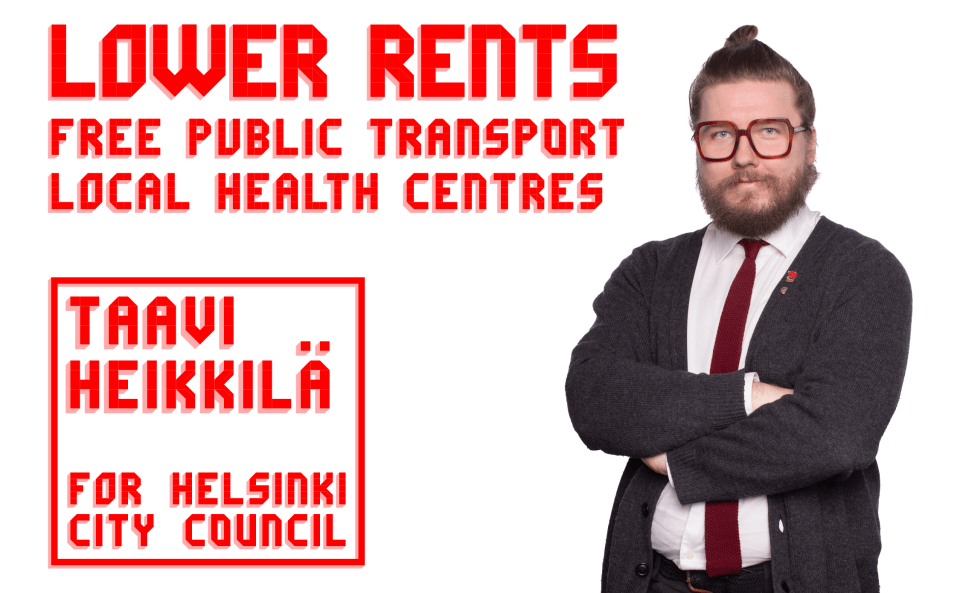
Taavi Heikkilä running for the City Council of the City of Helsinki in the municipal elections of 2025 representing the Left Alliance party – this is my election manifesto.
The Finnish language version of this page here.
Table of content
☞ 1. Lowering the rents
☞ 2. Free public transport (and new metro lines)
☞ 3. Local health centres (and other local services)
☞ Local matters
☞ Canditate pledges
Note that Finnish citizenship is not required for voting in the municipal elections: all EU and Nordic citizens living in Helsinki, and all citizens of 3rd countries who have lived in Finland for two years, are eligible to vote. Read more in the official election webpage: https://vaalit.fi/en/electoral-rights-of-foreign-nationals-in-municipal-elections-of-finland . (Note that in Helsinki there is no separate wellbeing county elections, only the municipal elections.)
From a Welfare State to a Welfare City
The Nordic welfare state has long been the basis of good society and the wellbeing of all its members. The welfare state has however been let to fall into decay and now the national government in power does actively work to eradicate whats remaining. When the state authorities do not do their part, the attention shifts to cities.
I want to live in a society where everyone has a cosy home, food on the table, care, the possibility to move around, the possibility to fulfil oneself, the feeling of belonging in the community, and care when that’s needed. Alongside humans wellbeing of humans the wellbeing if the nature must be ensured. If the state is not willing to guarantee the self-governing municipalities must. The City of Helsinki, if any, has all the possibilities to bear the responsibility of filling the basic needs of its residents – if we so decide.
To guarantee the wellbeing of coming generations the natural environment must be taken good care of. Fulfilling everyone’s basic need within the limits nature is possible only if the sustainably available resources are distributed fairly. In the current capitalist system, however, deciding on the usage and distributions of the resources is mainly in the hands of the private owners – and the owners who have hoarded the most to themselves have the most power in the shareholders’ meetings. To ensure the future wellbeing it’s thus crucial to extend democracy to the economy. Democracy grows from the grass-root level up and the self-governing municipalities can be important supporters of this democratisation – if we so decide.
Lowering the rents
In a good city everyone – regardless of their income or wealth – must have a cosy and appropriate home. The cosiness is about both the features of the apartment itself and the surrounding urban space. Essential elements of good living are certainty to get to live in one’s home as long as one wishes and on the other hand possibility to move when the needs and wishes change.
The cost of housing in Helsinki is not at a sensible level. For many the general housing allowance has for a long time been the only way to get by. Increasingly also the employed have to resort to the housing allowance and even the basic social assistance to manage the housing costs. The rising number of evictions after the benefits cuts and raises to the Heka apartments rents tells a lot about the availability of affordable housing.
The fundamental reason behind the expensiveness of housing is seeing apartments as means of profiteering and investment speculation mora than as a basic necessity. In market pricing the rents and selling prices go as hight as the people are capable of paying, even when the actual expenses are actually much lower. When there are no alternatives the most have to choose between excessive rent and homelessness. The private real estate investors will not fix the situation by themselves.
Making the city public housing, Heka, more affordable.
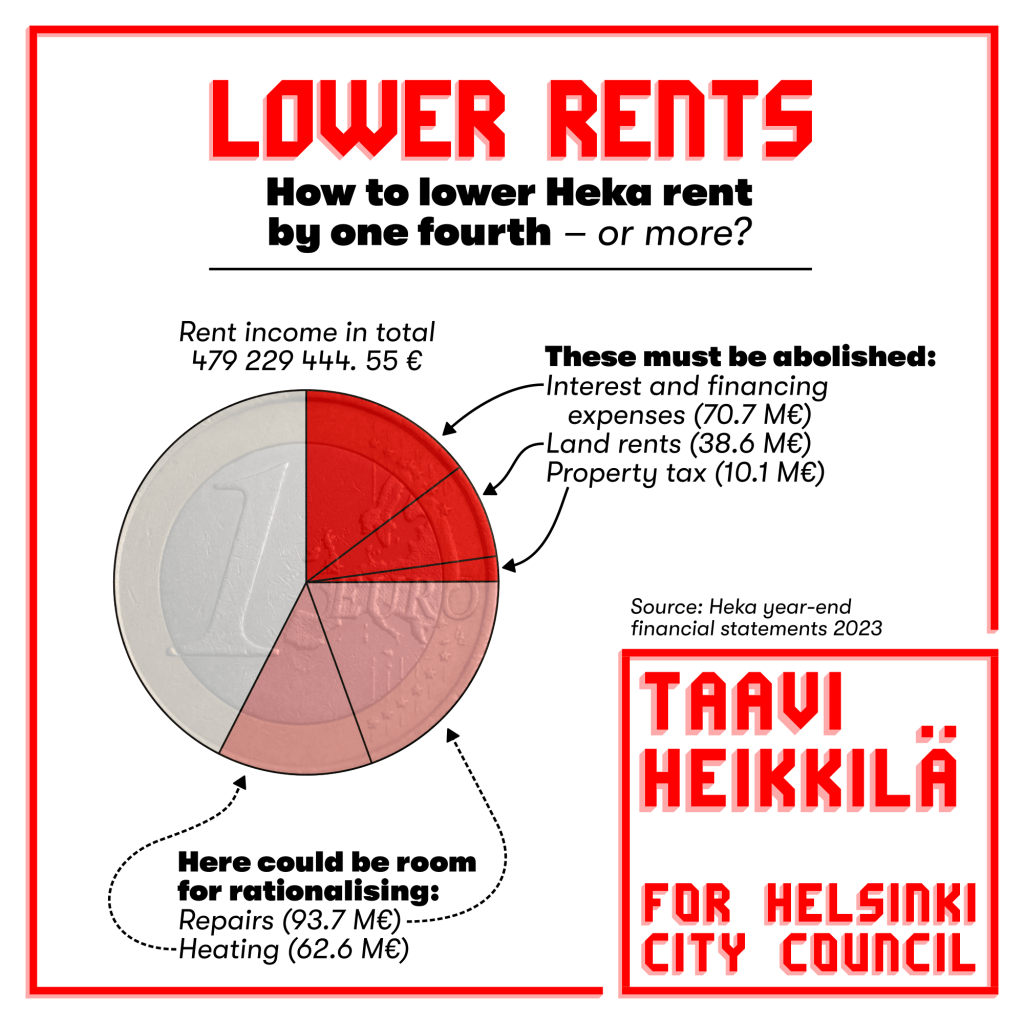
The city public housing must be made more affordable by capitalising away the expensive loans of the city housing company Heka and by financing the future renovations by saving in advance instead of loaning. Heka must be exempted from paying ground leases and property taxes back to the city. By implementing these measures, the rents of Heka could be as much as a third smaller than currently. The supply of Heka apartments must be increased by increasing the construction of new housing units significant and by decreasing the number of unused apartments. The model of rent balancing must be made more transparent.
According to the 2023 financial statements the interests and other financin expenses (70.7 M€), land rents (38.6 M€), and property tax (10.1 M€) – that is, expenses that go to financial institutions and the city instead of actual upkeep of the buildings – is equivalent to sum of one fourth of the total of rents collected in the same year (479.2 M€). If these expences would not exist the rents could be lower by one fourth. If on top of that other expenses could be rationalised without lowering residents’ the quality of living rents could be lowered even more. Rationalising could mean in practise lowering the renovation expenses by taking better care of the buildings or lowering the heatin expenses by investing in ground heat systems – by listening to residents and resident democracy organs a lot of other ideas could be collected.
The City must capitalise the current debts.
The City of Helsinki cannot wash its hand of the debt servicing costs raising the rents significantly. Lowering the cost substantially requires paying the debts away or refinancing them with cheaper money, which Heka cannot do by itself. The most efficient action would be the city to capitalise Heka by the debt balance enabling Heka to pay them away completely.
The future loans must be substituted by a renovation insurance.
By financing the future renovations by savin in advance taking new loan are not needed. The saving could be implemented by creating a renovation insurance where every housing unit pays premiums and then at then, at the time of renovation, gets a insurance payment covering the expenses without loaning. The idea of the model is similar than of the employment pension insurances, where on paper everyone saves for their future pensions but that is in practice a mechanism for allocating money from current payers to current pensioners via a financial buffer. The most transparent and trustworthy way of managing the system would be to establish a non-profit mutual insurance company offering only renovation insurances for the Heka housing units. The model could be introduced by first including only new apartments and then gradually existing ones.
The renovation insurance encourages better upkeep.
An important benefit of the renovation insurance model is that it would create a clear incentive for better maintenance: by investing in the upkeep the expected cost of the future renovation gets smaller, and the renovation moves forward in time, thus making the premium smaller. The lower expenses can be used to compensate the larger upkeep expenses. This is considerable difference to the current model where upkeep is shows only as an expensive cretin an incentive to cut costs.
Heka must be exempted from property tax and land rents.
Is highly contradictory for the city to be concerned about the financial situation of Heka and capitalise it occasionally, but at the same time collect continuously property taxes and land rents from it. The Act on Municipal Tax on Real Property allows lowering the tax of non-profit buildings to zero – and if the company form of Heka prevents applying this directly the city can just commit to pay the tax income from Heka back to Heka. The land lease agreements between Heka and the city must be remade lowering the rent to zero. Lowering the rents by the amount of the property taxes and land rents is doable if the city just wants to.
Rent regulation is the only certain way to lower rents
The City of Helsinki must enforce regulation on rents, prices and quality of new housing. The regulation could be implanted by including following it into the plot handover and ground lease contracts between the builder and the city. The acceptable rent or price ceiling per square should be based on real but reasonable building and upkeep expenses and the condition of the apartment.
What would change and why?
The aim of the reform is to guarantee that all renters and buyers get good apartments but don’t pay more than the real and reasonable expenses. The condition of the apartment would be taken into account so that rent or price ceiling would be lower if the apartment is in bad shape. If the resident has abundant money, they can refurbish the apartment and enjoy the results – the costs of the voluntary refurbishments, however, could not be transferred to others.
It would be natural to extend the regulation both on rents and selling prices. Only regulating rents could lead to weird situation where the value of an apartment is totally different when it’s used for renting or for selling, which could encourage to real estate shenanigans.
By including regulating quality in the rent and price regulation it can be made sure that the reform won’t lead to poor quality building and unpleasant living. In addition to the materials and architecture the quality regulation could be used to ensure better conditions to the building workers than the legal minimum.
The reform would not in itself ban making profit – profits would be possible if some private actor manages to build good quality housing more cheaply than the prevailing cost level. The reform would thus crate an effective incentive to get rid of unnecessary cost coming from bad planning, messy subcontracting chains, and other such factors. When new ideas come to general use the actual expenses, used for calculating the ceilings, could even go down over time. Restricting profits surely will affect how keen the private builders are to build and so the City must ensure realisation of building targets both by increasing its own Heka-production and by supporting the non-profit builders.
Rent regulation is opposed on flimsy grounds.
In the public discussion on rent regulation the loudest opposers often get the most attention. The typical counter arguments are: ”supply of rental apartments will go down”, ”the apartments will fall into disrepair” and presenting the rent regulation as an unthinkable idea in general. Each of these are on flimsy ground.
”Supply of rental apartments will go down.”
The claim on the decreasing supply is based on selective scenario, where there are no options for market lead production. By deciding on a level of housing construction when introducing the regulations, supporting non-profit builders and pledging to build the rest by the City can be maintained.
”The apartments will fall into disrepair.”
The claim is also based on selective scenario. By tying the rent ceiling on to the real maintenance expenses there continues to be enough money for the maintenance. Lowering the rent ceiling of apartments in bad condition creates a good incentive to take care of the apartments. In the current reality cutting on the maintenance is more a problem in investor heavy condominiums then in public housing, thus reducing the profits firs production could even reduce the short-term maintenance cutting.
”The rent regulation is a complete utopia.”
The perceived unthinkability of rent regulation tells more about the public debate on the economy moving rightward than about reality. Up until the beginning of 1990s the nation-wide rent regulation based on the law was the norm, to whitch the current unregulated rents are the deviation. In the former system the government set by decree the acceptable rents per square meter by area, by building year and by room count, and the acceptable reasons for deviating from the base rents. The renter had the right to challenge the reasonableness of their rent in court and to get the excessive part of the rent refunded for up to three years in past. The regulation did not prevent the major housing developments of the 70s and 80s.
Helsinki needs its own housing construction subsidy system.
Helsinki must establish its own subsidy system for supporting construction of affordable housing. Like the national subsidy system, the system would include subsidised building and renovation loans, and investment grants for housing of special groups like students and the elderly. The subsidies should be granted only to non-profits and the subsidised housing should not be used for making profits even indirectly.
What would change and why?
The aim of the reform is to ensure that Helsinki can enact its own housing policy regardless of the future of the national subsidy system. The Housing Finance and Development Centre of Finland (ARA), the state agency managing the system, has this far been a major enabler of the construction of affordable housing. Now the major budged cuts are made to the system in general and subsidies for right-of-residence apartment are terminated completely. Abolishing ARA as independent agency is not a good sing for the future of the system. The new Helsinki system could operate initially alongside the national system supplementing it.
Free basic electricity and electricity transmission
In addition to the direct expenses of the building the energy costs are an important part of housing expenses. The City of Helsinki owning its own energy company and the electric networks is well positioned to both lower the energy expenses of ordinary residents and to end the unsustainable energy production. The city must enact a system of free basic electricity, that is to offer all residents the electricity necessary for reasonable living free of charge. The electricity transmission fees of people must be abolished. All burning based production of electricity and district heating, including burning burning fossil fuels and biomass, must be ended at once.
Free basic electricity in practice.
Helsinki must define a reasonable level of basic electricity needs and organise the production of the city public energy company Helen so that all residents can be offered the corresponding amount of electricity without burning based production. The expenses of basic electricity system must be covered by city taxes instead of user fees. Things like wine cabinets and charging electric cars must not be included in the reasonable level but quota could be raised based on medical equipment on other actually necessary extra needs. The electricity needs above the reasonable level would be covered by making a contract with the electricity company of choice as is done now. Helen would continue selling electricity in market rates and the reform would not affect the corporate clients. Fulfilling the basic electricity needs and maintaining the transmission networks are parts of the basic infrastructure, the expenses of which must be distributed among all based on the ability to pay.
Transition to sustainable energy production in practice.
The city energy company Helen must at once end energy production based on burnin. District heating must be based entirely on heat pumps, geothermal heat, heat storages and small nuclear production. Replacing fossil burning by burning biomass is no a solution – regardless of artificial emission calculations the carbon raising from a chimney doesn’t care weather is has come from biomass that is fresh or that has fossilised over millions of years. Some of the existing burning based heating plants can be kept in usable condition for ensuring security of supply.
More rationality into the residential parking.
Underground parking facilities are remarkably expensive and these costs unavoidably trickle into all residents’ housing expenses. The current regulation setting parking minimums must be replaced by setting parking maximums. In housing units well served by public transport no more parking places are needed than some singular places for residents with reduced mobility and the couriers. Some number of parking places is needed also in the future for those who have an actual need, like having to commute with heavy work equipment, for using a car – these places must be placed by default into above ground parking buildings operated by the city, where the places are kept reasonably prices and are distributed based on actual need. As the share of electric cars goes up so does the risk of battery fires, thus making the separate parking buildings also a matter of safety. Market-based parking is a bad solution as competition by money inevitably leads to places being allocated to the wealthiest luxury motorists regardless of the actual need.
Free public transport – and new metro lines
In a good city everyone regardless of weather, physical fitness, income or wealth can move around – best way to make this possible is comprehensive free public transport. Ticket fees are a direct financial incentive to not go anywhere. Alongside the public transport walking and cycling must me encouraged, which requires developing a network of pedestrian and cycling way that it safe for everyone and that is well kept around the year. Private motoring is a highly inefficient way of moving people around in a city – in addition to abolishing the ticket fees best way to promote more sustainable transportation is to make public transport and cycling the most convenient ways for commuting all around Helsinki region. Extending the metro network would be an excellent way to ease up regional transportation.
The free public transport in practice.
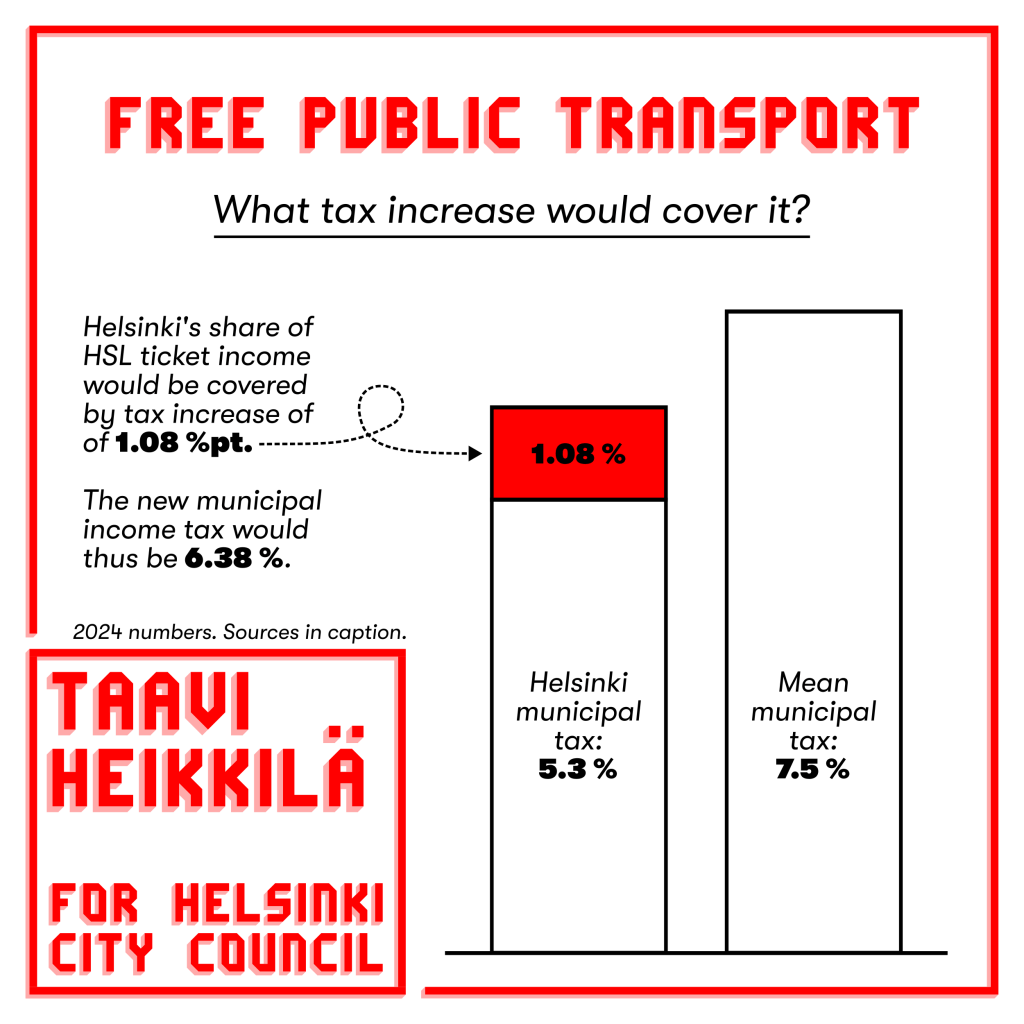
Currently about half of the expenses of the Helsinki Regional Transport Authority (HSL) are covered by the member municipalities and half by ticket fees. In 2024 HSL collected 372.2 M€ of ticket income and Helsinki’s share of this was 217.8 M€. In the same year the municipal tax rate of Helsinki was 5.3 % and tax income 1068 M€. Thus, the Helsinki’s share of the ticket income could have been covered by a tax increase of 1.08 %-points. After such increase the tax rate would be 6.38 % – which is still considerably less than the national mean of 7.5 %.
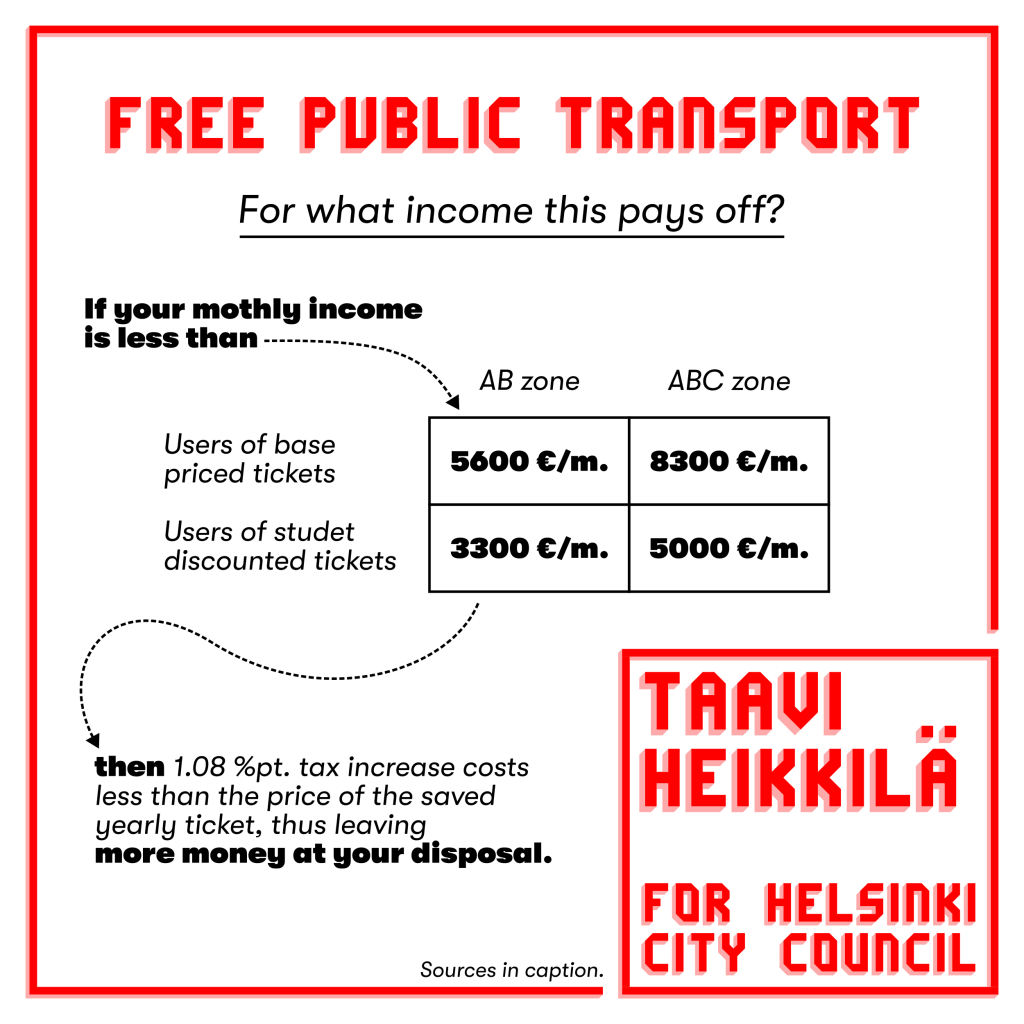
In practice the result of tax funded free public transport would be, that low and middle income residents of Helsinki would be left with more money at their disposal. Users of student discounted AB zone ticket earning 0–3339 €/month, users of student discounted ABC zone ticket earning 0–4984 €/month, users of base priced AB zone ticket earning 0–5565 €/month, and users of ABC zone ticket earning 0–8307 €/month would be left with more at their income. With zero income the tax increase is also zero so they would be left with the full amount of the saved price of the ticket at their disposal.
As a HSL member Helsinki must promote free HSL public transport. Abolishing the fees would also allow abolishing the expensive ticketing system. If the other municipalities are not willing to make the whole HSL transport free Helsinki must by itself offer free public transport for all residents and employees of Helsinki. The free public transport only for Helsinki residents would be best to implement so that the city pays the fraction of the total expenses of HSL that corresponds the fraction of trips made by the Helsinki residents.
Convenient regional transport by new metro lines.
In addition to abolishing ticket fees convenient transport requires fast and convenient connections. Moving along the metro and train lines is quite easy but in between these radial lines there is much room for improvement. Extending the light rail lines outside downtown tram zone is a good but insufficient solution: boulevardisation of the incoming highways would unavoidably mean longer travel times for the people living outside the planned light rail lines who currently use quite fast highway buses. The current rail network, especially among the metro corridor, is vulnerable to traffic disruptions and changing between the metro and train lines at the Central Station is not so convenient.
The most efficient way to make regional trips more convenient and the current network less sensitive to disruptions is to extend the network by new radial and transverse metro lines. The lines could, for example, be a north-south line Jätkäsaari–Kamppi–Pasila–Maunula-Torpparinmäki, and east-west line Itäkeskus–Viikki–Pasila–Tapiola and a branch from new eastern line towards Jakomäki and further. The new lines would create a new alternative east-west route and a more convenient transfer point to trains at Pasila station. The lines could be continued in the future from Torpparinmäki towards airport and further and from Jakomäki towards Hakunila and further.

The North-South metro
The line would essentially connect the busy West harbour ferry terminal, Meilahti hospital area and the areas midst the Ring Rail to the regional heavy rail network. The line could be continued in the future towards the airport and even further. The stations of the lines could be:
- West harbour passenger terminal (transfer to ferries)
- Punavuori
- Kamppi (transfer to current metro)
- Töölö
- Meilahti hospital
- Pasila station (transfer to local and long-distance trains, and to the other new metro lines)
- Koskelantie crossroads
- Käpylä station (transfer to Main Line local trains)
- Maunula (tranfer to circular light rail 15)
- Pakila (tranfer to Ring I:n transverse bus lines)
- Torpparinmäki (transfer to Tuusula Highway local and long-distance buses)
- (option for further continuation)
The new East-West metro (the Science metro)
The line would essentially create a new parallel connection between Eastern Helsinki, Pasila and Espoo. The parallel connection could be used as a detour during traffic disruptions of current metro line and in normal condition it would fill in the capacity of it. The line would also essentially connect the university campuses of Kumpula, Viikki, Otaniemi, Myllypuro and Pasila into an interconnected campus zone (much better thant the proposed Science Tram). Moving the Lahti Highway / Ring I intersection underground would free a big lot for infill development, and it would be natural location for a regional bus terminal. The line would use the existing Myllypuro and Itäkeskus stations in its eastern end. The stations of the line could be:
- Itäkeskus (current station; transfer to existing metro)
- Myllypuro (current station; transfer to Mellunmäki branch of the existing metro)
- Kivikonsolmu (a possible location for infill development and a new bus terminal)
- Viikki Campus
- Vanhakaupunki
- Kumpula Campus
- Pasila station (transfer to local and long-distance trains, and to the other new metro lines)
- Ruskeasuo
- Munkkiniemi
- Aalto University (in Espoo; transfer to current metro)
- Tapiola (in Espoo; transfer to current metro)
The South-East metro
The line would essentially connect the Jakomäki direction between the Main Line and current metro into the regional heavy rail network. It would be natural to continue the line vie Jakomäki to Hakunila where it would meet the upcoming Vantaa tram line. The line would share track with the southern part of the North-South and the eastern part of the new East-West line. The stations of the line could be:
- West harbour passenger terminal (transfer to ferries)
- Punavuori
- Kamppi (transfer to current metro)
- Töölö
- Meilahti hospital
- Pasila station (transfer to local and long-distance trains, and to the other new metro lines)
- Kumpula Campus
- Vanhakaupunki
- Viikki Campus
- Kivikonsolmu (a possible location for infill development and a new bus terminal)
- Jakomäki
- Hakunila (in Vantaa; transfer to Vantaa tram)
- (option for further continuation)
Better employment by municipalised bus traffic.
Public transport is a stable public service now and in the future and the workers making it happen must get to enjoy this stability. Currently the public transport authority HSL is only responsible for arranging the traffic by subcontracting the practicalities to separate entities. Commuter trains are operated by the state railway company VR, other rail traffic by the Metropolitan Area Transport Ltd, and buses via competitive tendering by plurality of private bus companies. The public tendering of the buss traffic forces the bus companies to regularly compete each other in who’s the most successful in cutting the working conditions and benefits of their employees. For the drivers this means regular insecurity on the continuation of their employment contract.
The best solution both for residents and the public transport workers would be to municipalise buss traffic into HSL. In practice this would mean hiring the drivers and maintenance staff as direct permanent employees of HSL, and to buy in the buses and depots to direct HSL ownership. Alongside benefitting the workers this enable more comprehensive and better planning of buss purchases and depot locations. Regardless of who operates the lines HSL must take the responsibility to ensure proper toilet and break facilities for the drivers – no driver should be forced to pee in the bushes in the midst of their work shift.
Local health centres – and other local services
In a good city the essential services for good everyday life and places to be are close by – preferably within walking distance from home. Neighbourhoods or urban suburbs (lähiö in Finnish) are an excellent way of distributing the local services around the city. The so called ”15 minutes city” is not a new innovation but combining residential areas, suburban mall and public transport connections has been a core of human centred city planning since at least the 70s. The city produces a good deal of local services by itself, and it has the planning authority to control where commercial services locate – thus it has a great responsibility on the rational distribution of services and the vitality of the suburbs. The best way to serve the residents is to improve and repair the existing suburbs – not to bulldoze them out of the way of private investors’ new shopping centres and posh apartments.
Local health centres
Public healthcare is the cornerstone of the welfare state and an essential local service. Best healthcare is to provide help quickly and at a low threshold before the condition gets worse – a familiar team of healthcare professionals at one’s own local health centre is an excellent way of organising this. Meeting healthcare professionals physically must be primary way of getting help now and in the future. Remote connections, like chats, must only be used to supplement the physical visits and using these must be truly voluntary to the patient. Qualified human professionals must not be replaced by AI services under any circumstances, not even in the text chats.
Closing local services and concentrating them into large centres is a step to the wrong direction. Especially now when the state government actively tears down the public health care system and weakens the minimum standards of care Helsinki, acting as its own wellbeing services county, has a a special responsibility on the health care of its residents. Helsinki must keep at least its current health centre density, with the new neighbourhoods under construction the need is to increase it if anything. In addition to the physical services network Helsinki must keep at least the current times of treatment. The health centre services must me free of charge.
Better working conditions by workplace democracy.
The unhealthy hierarchies within the healtcare workplaces are dismantled best by advancing workpalace democracy. The local health centres, that are more humane size working environments, are much better base for endorsing worker democracy than larger units. The nurses, physicians, and other professionals have the best knowledge on how things are best done at the practical level – thus unit specific decisions are best to be left for the workers of the unit. In every local health centre, a democratic administration model must be introduced, where the highest decision making body of the centre is the unit council elected by the workers of the unit. The model can later be extended into large units and their subunits.
HSL minibus for every health centre.
However dense the health centre network not all elderly or ill can walk there themselves. Currently the transport is organised by HSL neighbourhood routes, by ambulance or by taxi – however the frequency of the neighbourhood routes is quite poor and due the deregulation of taxi services organising them is a fuss. A good improvement would be to assign a HSL minibus and a driver to each health centre. With good planning the buses could both charter transport patients from their doorstep and drive some scheduled neighbourhood route services near the centres. A familiar and trained driver would be good especially for frequent health centre visitors. The minibuses could also be used to transport samples and rotating personnel between health care facilities.
Old health centre building to good public use.
The health centre buildings must be kept in good condition and in the ownership of the city. The unit councils elected buy the workers of the centres must be given power on the upkeep of the buildings. If it’s necessary to move a local health centre into new premises within the locality the old building must be kept in city ownership and taken into good use for example as a community houses, youth centres or day cares.
Local services
The city must ensure that the basic services needed by the residents by daily basis are found in every suburb. Every suburb public services include at least
- local library,
- local day care centre,
- local comprehensive school,
- local youth centre and
- city public cervices point.
Cultural centres, adult education centres, upper secondary schools, vocational schools, nursing homes must be found comprehensively all over the city – if not in every suburb at least in a near one. The city must ensure that there are local grocery stores also for the first residents of new areas and that the large stores will not run down the network of local grocery store within walking distance.
Local library is a public living room.
The general purpose of the libraries is to bring information available to everyone. Lending books, inviting authors to speak on their books, school collaboration, and providing computers and the day’s newspapers are the core of libraries now and in the future. The library buildings have an important function as public living rooms – in the throughly commercialised urban space the libraries are the rare places, where everyone can spend time without the pressure to buy anything. Free of charge meeting and event facilities are a great support for small organisations and other civic activities. The opening hours of libraries and the availability of meeting rooms must be increased.
In day care centres small is good.
The purpose of day care centres is both to raise the children safely into members of the community and support the parents by taking care of their children on behalf of them – both are achieved best by centres that are close home and humane in size. Closing small day care units and concentrating children into large more sparsely located units is not the right direction. In all day care centres, regardless of unit size, the proper guidelines of interior and outdoor space per children must be followed.
In city public service points everyone can get help without digital devices.
Following the example of the cities of Espoo and Vantaa, Helsinki must create a city-wide network of service points where everyone can get advice and assistance in using public services. The points must act also as service points of the public transport organisation HSL. Currently updating the discount group and other in person things can be done in multiple service points in Espoo and in Vantaa, whereas in much populous Helsinki there is only a single congested and cramped HSL service point.
Local parks and the Central Park
In a good city there is room for nature. The nature is about areas cherished for the natural ecosystem for the sake if itself and about parks and green areas aimed for more human use. Especially during summers, the parks serve as free public living rooms and hang out places. All currently existing old forests, other valuable natural sites, and local parks must be protected for construction. All public parks must include public toilets usable around the clock. All new residential areas must include parks and street greenery.
The Central Park especially must be protected from construction in its entirety within clearly defined edges. The vague definition of the park edges cannot be a back door for incremental shrinking. The highways bordering the Central Park must be equipped with noice barriers to protect park from noise. If some car tunnels are dug in Helsinki, it should be moving underground the section of Ring I splitting the park.
Local democracy
No decision maker can know the needs and wishes of others on behalf of them – the idea of democracy is to enable taking everyone’s needs and wishes into account by including everyone in the decision making. In a functioning democracy the members of a community have maximum say in the decision concerning the community and the differences in how much say everyone has is minimal. The municipal elections implement the idea reasonably well as for the city-wide decisions, however as for local decisions the decision making remains far too distant. The members of the city council and committees must do much of their decision without firs hand knowledge not personal connection to the consequences.
The local democracy must be fostered by decentralising local matters into new borough councils. The matters could include at least deciding on the upkeep of streets, parks and other public areas. The borough councils could also act as intermediaries between the local residents and the city in matters of city planning and budgetary decisions. In addition to new organs the power of existing youth council, elderly citizens council, council on disability, and other, must be increased relative to decisions falling within their field of competence. The meeting documents and decision bulletins of all official decision-making bodies of the city must be published at least in Finnish, in Swedish and in English.
The borough councils in practice.
A borough council must me established for every of the 60 city districts called kaupunginosa in Finnish. Each council would be elected by residents its operating area. The councils would meet within their operating areas, and they could nominate non-voting representatives of the local associations or decided to make the meetings open. Deciding on the upkeep of the streets and other common areas could be organised so that the city council decides on the overall resources by budged, the urban environment committee decides on the allocation of maintenance staff and equipment between the districts, and the borough councils decide how to put the resources into use in their operating area. The administrative staff serving the borough councils should have their office premises in the borough in question to make sure that the staff has a first hand connection to the area they are serving.
Borough councils and more democratic city planning process.
The city planning process must be updated so, that before the final decision making the matter is sent to the relevant borough council or councils. The final decision would be based on the official proposition including the possible alterations by borough councils. The borough councils must be given the power to dismiss the whole matter, so that if the committee would still want the matter to be approved the final decision would automatically be transferred to the city council. The idea is to create more direct and effective channel for the residents to have their say. The current process in provides in principle aways ways to express ones opinion, if one knows when to do so, but listening is fully in discretion of the committee. In planning processes initiated by private investors this discretion is often not in the side of the ordinary resident. The actual powers of the borough councils would force the urban environment committee to listen better the local residents.
Borough councils and more democratic budgetary process.
The process of deciding the city budged must be updated so that before the negotiations among the city council groups an official budged draft is published and sent to borough councils. The yearly budged is the single most important yearly decision steering the city organisation – currently the draft negotiated behind closed doors leaves the city council to act largely as a rubber stamp. In the new model the process starts with an official public draft, that is the best estimate of the city civil servants on how the last year’s budget would look now considering the price and demographic changes. The draft would then be sent to boroughs councils for them to propose changes. The official draft and the borough council propositions would be the base of budged negotiations. The idea is to increase the transparency of the budgetary process and to force the city council groups to be more open on their political positions with respect to the official draft and the borough councils, instead of agreeing on matters in secret.
Local matters
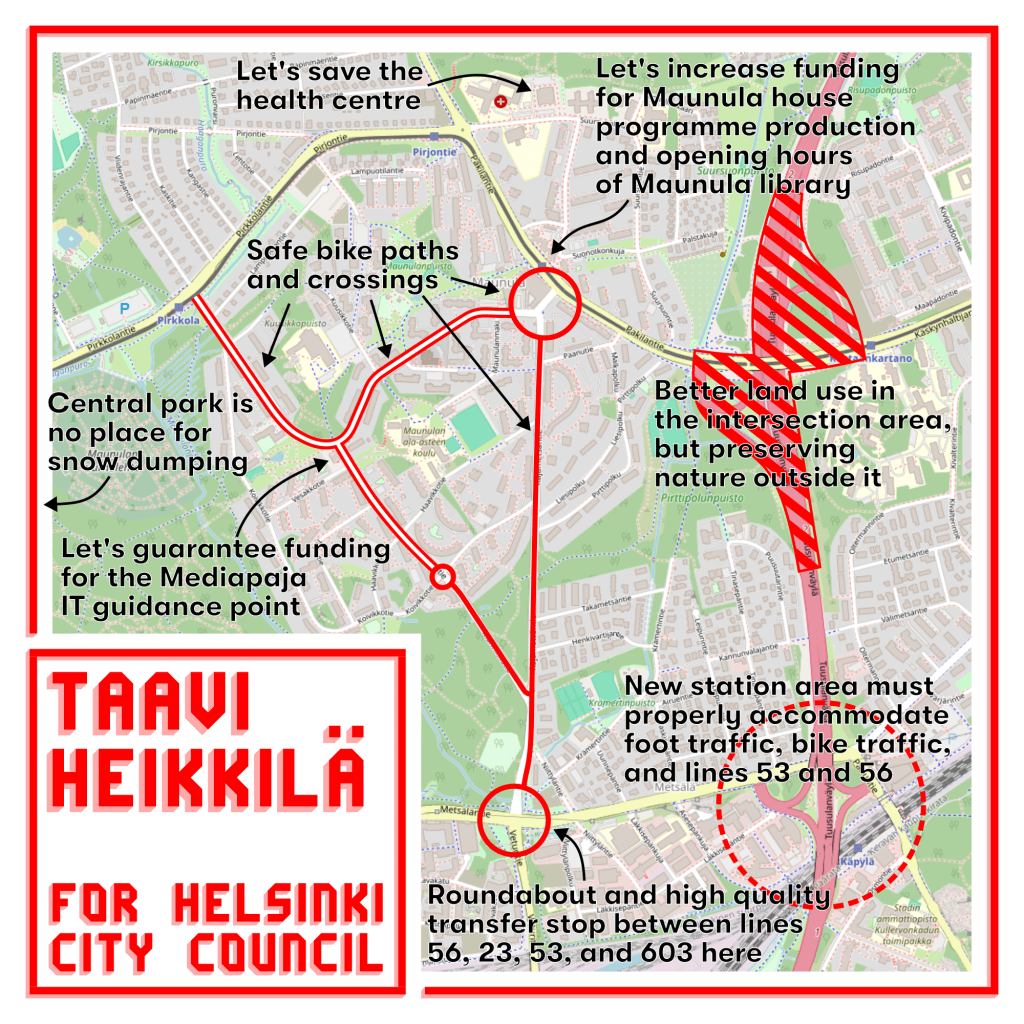
Every city councillor and decision maker lives and moves around somewhere in the city – these first hand experiences inevitably influence one’s the decisions and knowledge. I myself would represent especially Maunula, where I live, and Kumpula, where I study and work at the campus area. As a former resident of Töölö and Kontula-Mellumäki region, and as a former long distance bus commuter, something about these must also have sticked in my mind.
Maunula
Saving the Maunula health centre.
Maunula has a well-functioning health centre. However the city has plans to concentrate all health centres of northern and north-eastern Helsinki to Oulunkylä, which would mean closing the Maunula, Paloheinä and Pihjalanmäki health centres. Concentrating would significantly weaken the regional coverage of basic health services and the plan must not be carried out. Maunula, Paloheinä and Pihjalanmäki health centres must be kept open. Building a new spacious building in Oulunklä is not a problem in itself – the surplus space due keeping local centres open could be put into use by offering it to the student health service YTHS to replace the small Malmi service point by a better one, or by building wards for the elderly incapable of living by their own.
Cycle lanes to Männikkötie and Metsäpurontie.
Out of the main roads going through Maunula only Rajametsäntie is equipped with cycle lanes separate from cars and pedestrians – similar ones should also be added to Männikkötie and Metsäpurontie. The road safety could be increased by transforming the Männikkötie/Metsäpurontie junction, why not also the Männikkötie/Koivikkotie and Männikkötie/Rajametsäntie junctions, into roundabouts. The current two-way path on the eastern edge of Rajametsäntie is a functioning one and it should not be replaced by separate one way paths. From the cycling point of view the recently renewed Rajametsäntie/Metsäpurontie junction seems to be poorly designed and it should be thought again regardless the possibly new cycle paths of Metsäpurontie.
Smoother transfers from Maunula to line 56.
Usually the best connection from Maunula to Käpylä-Kumpula-Kalasatama direction is to first use line 23/63/53 and then transfer to line 56. Widening and the new traffic lights of Metsäläntie have already made transferring at Postiljooninkatu stop worse – in the future when 23/63 are changed to stop on the other side of city block on Postiljooninkatu the transfer becomes lousy. The transfer could be made smoother again by replacing the large Metsäläntie/Rajamietsäntie junction by a roundabout and moving the near by Niittyläntie and Vaskisepäntie stop pairs in contact with it. A well-designed roundabout without any waiting the lights would allow really quite smooth transfers. There is plenty room for the roundabout, and it would also be good for the cycle traffic crossing the junction.
The possible Tuusulanväylä city boulevard must become a pleasant urban environment.
In one hand transforming the highway like inner entrance roads to boulevard like urban space is in itself a good idea. In growing Helsinki the land currently occupied by interchanges and the noice zones of the entrance highways have better use. In the other hand the boulevardisation must not become a justification to demolish the parks outside the current highway zones and turning the boulevards, that still act as the main entrance ways to the city, into nice urban areas is challenging. If the Maunula interchange of Tuusulanväylä is to be developed the Pirttipolunpuisto park must be preserved and the pedestrianised main side of the new boulevard city must the Pirttipolunpuisto side – even as a city boulevard Tuusulanväylä would most likely have too much traffic to allow pleasant outside sitting in that side. The Käpylä station interchange zone is an excellent place for a transfer bus station and more efficient buildings. The constructions around Käpylä station must be planned to allow lines 56, 53, 603 and 69 to pass the station uninterruptedly for the whole construction phase. If the new Tuusulanväylä fast tram means shortening the lines 66 and 67 into feeder lines the substitute lines going through central Maunula must be more frequent and with better hours than the current lines going to central Helsinki. The massive Pasila shopping centre is so close that the area does not need new shopping centres, instead the new commercial premises bus focus on daily services of the new residents and supplement the services not currently missing in Maunula.
Kumpula
Smoother line 56.
The line 56 connecting the Kumpula campus with the metro and commuter train networks must be made faster, more reliable and its capacity must be increased. The line is currently regularly quite congested and especially crossing the Koskelantie junction can be tedious at times when a lot of cars are on the move. The actions to take could include at least:
- Speeding up the Koskelantie/Intiankatu junction by editing the traffic light cycles, by transforming the junction into a roundabout, and/or by restricting car traffic on the north end of Intiankatu.
- Adding separated bus lanes on Asesepäntie and Metsäläntie.
- Restricting car traffic on Työpajankatu between Vanhan Talvitie and Hermannin Rantatie (or moving the Kalasatama stop under the metro station and the terminus to the south side of the metro track).
- Replacing the current buses by the larger electric bendy buses, and doing the necessary small adjustments on the tighter junctions around Kumpula hill.
- Adding separate stopping spots at Käpylä station for lines making planned schedule catching stops at the station.
Safer Kumpula campus pedestrian crossing.
The pedestrian crossing over Kustaa Vaasan tie at the Kumpula campus bus stop is the main passage between the campus, the plurality of public transport stops, and the Arabia mall – the cars driving fast and against red lights make the crossing an everyday thriller. Everyone using the crossing on a regular basis has probably either seen a dangerous situation or been involved in one. Automatic speed cameras must be added on both directions at the crossing for getting some actual sanctions for driving over the speed limit and/or on red lights. Currently even filing a police report on red light driving with witnesses does not seem to lead to any consequences. Ideally, in addition to the speed cameras, the speed limits could be lowered and speed bumps installed around the crossing – among small inconvenience drivers and the safety the users of the dangerous crossing the latter must always come first.
The location of the Helsinki Upper Secondary School of Natural Sciences must be re-evaluated if the good of the university so demands.
The upper secondary schools was placed on Kumpula based on inadequate information by the university – when the building was intentionally designed so small that the school must regularly operate partly in the uni premises the did not tell the city that this was purely a premises cut that was not ran by the students nor the teaching staff before making the decision. The number of students and staff on the campus is increasing and instead of cuts there is already need for more space. If the growth of the uni campus continues it would be best that the city would relocate the upper secondary school and leave the building designed for educational use and already owned by the university for the use by the university.
Eastern Helsinki
Keeping the Itäkeskus bus terminal as is.
The new commercial building planned on the site of the current Itäkeskus bus terminal must not be build. The plan would transform the well functioning and understandable terminal important for the whole eastern Helsinki into a messy side hustle of a commercial building. The new smaller terminal would limit larger increasing of buss traffic in the future and it would make transfers more difficult – in the plans transfers both to buses and between the eastern metro branches would require zigzagging though the commercial centre. Even now when the planned building has luckily not been constructed it is reason why the terminus of tram 15 has been left so far on the temporary location outside the bus terminal. Itäkeskus is already a massive shopping complex and the existing bus terminal area must not be sacrificed for good of private real estate investors.
Östersundom must either be build around metro on not at all.
The Östersundom area was forcibly annexed into Helsinki with the intention to make it a new suburban development area for the growing Helsinki. The planning has slowly moved forwards and it has contained the good option of connecting the Mellunmäki metro branch into the area – however in the latest draft the metro connection has been replaced by tram. Sparser urban structure, slower public transport connection requiring transfer for getting to city centre direction, and locating the cores of the development near highway intersections all scream planning towards a car suburb. From the nature point of view, it’s a good question whether the whole project is good in the first place, but if Östersundom area is built it’s better locate the same amount of apartments more densely around metro stations. Claiming that planning requiring more existing nature to be bulldozed from the way of sparser urban structure and traffic planning encouraging into driving is more natural is just dishonest. A new development area near a terminus of an existing metro line as a rare opportunity in Finland and it would be absurd to just throw it away.
Downtown.
Keeping the Elielinaukio bus terminal.
The plan to close the Elielinaukio bus terminal and replace the area by a new office and commercial building would be significant loss on the downtown public transport connections. Changing the bus lines now terminating at Elielinaukio to terminate at Kamppi is an imminent risk to the current and future capacity on the Kamppi bus terminal. The connections to the regional core must be prioritised over the interest of private real estate investors. Instead, moving the terminal one level down underground could be investigated with giving the residents an actual possibility to come with ideas on the usage of surface area.
Keeping the Merihaka student housing units.
In planning the upcoming renovation of the Merihaka area one of the possible options is to demolish the student housing foundation unit HOAS Hakaniemenranta 12 and to replace it with larger residential buildings. Even though the same number of student apartments would be assigned in the new buildings the demolishing and rebuilding the existing quite cheap apartments, even by the standards of student housing, would unavoidably mean higher rents. The new larger buildings would also threat the architecturally valuable build environment of Merihaka. If something new is to be built in Merihaka the parking building in the western edge of the area could be replaced by Heka public housing, rare in the Hakaniemi-Sörnäinen axis.
Candidate pledges
As a candidate I’ll commit to the following candidate pledges of civic organisations (the English translations of the material that is only available in Finnish are unofficially by me):
Helsinki Region Cyclists’ Municipal election campaign (Kuntavaaliteesit Helsingissä 2025)
Read more (in Finnish): https://pyoraliitto.fi/pyoravaalit-2025/helsinki/
The objectives of the campaign are:
- Detour routs (of construction sites) to order
- Winter maintenance to order by brushing and better ploughing
- Faster building of the planned core network
- Making city bikes run year around
More about my proposals for cycling in maunla, see. Cycle lanes to Männikkötie and Metsäpurontie.
Heka residents’ Municipal election campaign (Teesit Kuntavaaliehdokkaille)
Read more (in Finnish): https://www.hekalaiset.fi/kuntavaalit-2025/
The pledge is, as a city councillor, to
- advocate for city of Helsinki to do its’ share on financing construction,
- be on the side of Heka residents and demand their rent money to be used well,
- advocate for easy switching from a Heka apartment to another,
- bring the voice of the Heka residents to the City Council.
More about my additional propositions for making Heka apartments more affordable, see Making the city public housing more affordable.
The Finnish Association for Nature Conservation (Kuntavaalit 2025: Lähimetsäsitoumus)
Read more (in Finnish): https://www.sll.fi/opi-lisaa/metsat/kuntavaalit/sitoumus/
The pledge is about defending the local forests from building and cutting by
- demanding the decisions are bases on comprehensive and up-to-date nature inventories,
- seeking actively solutions for directing building to take place on underutilised already built areas instead of nature areas,
- checking the need for updating the forest policies of the municipality (so that there would be no monetary cutting targets, recreational forests would not be transformed to commercial forests, and biodiversity of the municipal commercial forests would be increased),
- promoting significant increasing on protections on municipally owned forests so that that at least 30 % of their are would be protected in accordance with international biodiversity targets.
Read more on Local parks and the Central Park (and also on the sections on Tuusulanväylä and Östersundom).
The pledge campaign of LGBTIQ Rights in Finland – Seta
Read more (in Finnish or Swedish): https://seta.fi/ihmisoikeudet/vaalit-ja-kampanjat/kunta-ja-hyvinvointialuevaalit-2025/
The pledge is to:
- actively advocate for rights and wellbeing of gender and sexual minorities in municipalities and wellbeing services counties,
- work against hate speech and discrimination targeted at the LGBTIQ people,
- ensure that the gender and sexual minorities’ own voices are heard in the decision making.
The pledge campaign of Sumud – The Finnish Palestine network
Read more in English: https://vaalilupaus.eu/english
The Helsinki Association for Nature Conservation (Helsingin luonnonsuojeluyhdistys ry)
Read more (in Finnish): https://www.sll.fi/helsinki/uutiset/helsingin-luonnonsuojeluyhdistyksen-kuntavaaliteesit-2/
The campaign points are:
- New construction must not diminish the area of the nature areas in Helsinki
- The planning must be based on comprehensive and up-to-date nature inventories
- More nature to the city
- Real interaction must be included in the planning
- The unique sea nature must be protected
- Helsinki must have more ambitious climate policy
- The national city park must be realised as large enough
- Destruction of the cultural and building heritage of Helsinki must be stopped
National city park to Helsinki movement (Kansallinen kaupunkipuisto Helsinkiin! -liike)
Read more (in Finnish): https://kaupunkipuisto.fi/
The campaign is about declaring a large and interconnected set of green areas within Helsinki into a protected city park of national importance.
Lapinlahden Lähde: Saving the Lapinlahti park
Read more (in Finnish): https://lapinlahdenlahde.fi/ei-satamatunnelia-lapinlahden-puistoon/
The campaign is about saving the Lapinlahti park from a multi lane entrance of the proposed Harbour tunnel (”Satamatunneli”) that is being planned within the park.

Page updated 6.4.2025.
 Politiikkaa, hallintoa, avaruutta (yms.)